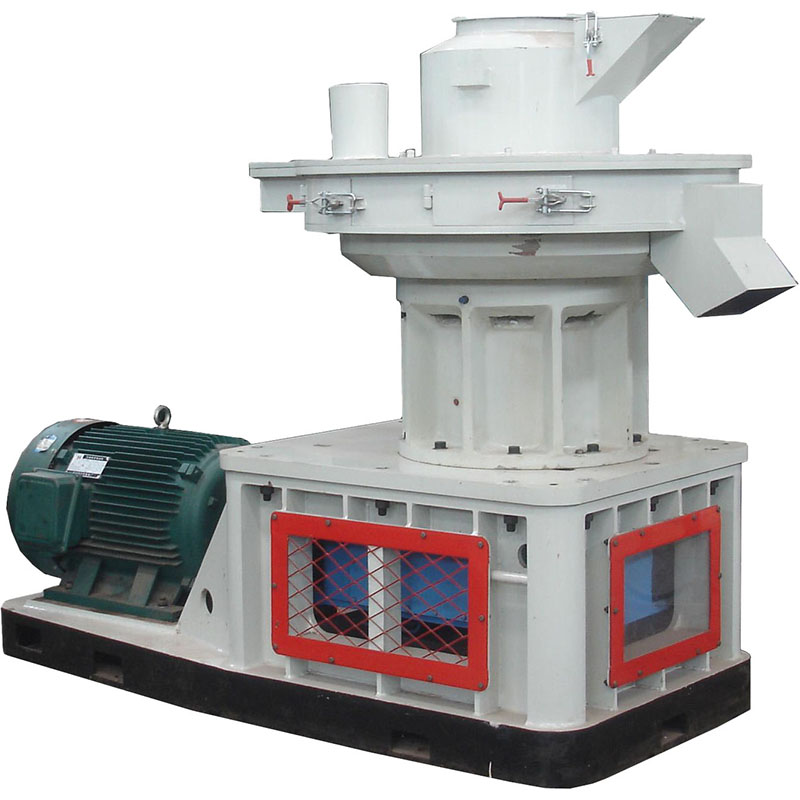
Model 560 Vertical Ring-Die Wood Pellet Mill
Featuring a vertical die feeding setup, the raw material feeds directly into the pelletizing chamber by gravity, ensuring uniform material distribution without clogging. Driven by a robust electric motor and a heavy-duty gearbox, the rotating rollers press the raw materials outward through the precision-machined vertical ring die holes. Under high pressure and friction, the biomass is formed into dense, uniform cylindrical pellets continuously.
Key Features & Advantages- Vertical Ring-Die Design: Allows raw material to drop directly into the pelletizing chamber, preventing material bridging and ensuring higher feeding efficiency.
- Heavy-Duty Gearbox Transmission: Equipped with a high-torque industrial gearbox for stable power transfer and 24/7 continuous heavy-load operation.
- Forced Feeding Mechanism: Comes with a specialized paddle feeder to force light, fluffy biomass materials evenly into the pellet die.
- High-Precision Alloy Ring Die: Double-sided usable ring die made of wear-resistant alloy steel, significantly lowering operational costs.
- Independent Lubrication System: Features automatic and manual lubrication options to ensure bearings operate under optimal cooling and greasing conditions.
| Parameter | Specification |
|---|---|
| Model | Model 560 Vertical Ring-Die Pellet Machine |
| Motor Power | 110kW (Industrial 380V / 50Hz / 3 Phase) |
| Capacity | 1100 – 1500 kg/h (Depending on Raw Material) |
| Ring Die Inner Diameter | 560 mm |
| Pellet Diameter Options | 6 mm / 8 mm / 10 mm / 12 mm |
| Dimensions (L × W × H) | 2400 × 1200 × 2100 mm (Approx.) |
| Net Weight | 5,500 kg |
The Model 560 is ideal for large-scale processing of various wood and agricultural residues, including:
- Hardwood and softwood sawdust, wood chips, and forestry logging residues
- Sawmill wastes, furniture factory shavings, and bark
- Agricultural stalks, rice husks, palm fiber, and peanut shells
- Moisture Content: Controlled strictly between 12% and 15% for optimal ring die compression.
- Particle Size: Fine particles under 5 mm (crushed by a wood hammer mill beforehand).
The produced biomass fuel pellets feature high density (1.1–1.3 g/cm³), high mechanical durability, and a clean, smooth surface, conforming to international export standards.
- Commercial Heating Plants: Large-scale biomass boiler fuel.
- Industrial Power Generation: Co-firing biomass fuel in thermal power stations.
- Wholesale Fuel Distribution: Premium bagged wood pellets for European and Asian residential markets.
- Roller & Main Shaft Greasing: Inject high-temperature grease every 4–6 hours of heavy-duty operation.
- Ring Die Maintenance: Clean the die holes with an oil-sawdust mixture before shutting down the machine to prevent blockage from cooling residues.
- Roller Clearance Check: Regularly adjust the gap between the ring die and rollers (maintained at 0.1–0.3 mm) to maximize component lifespan.
- Ring Die: High wear-resistant alloy steel, average lifespan of 800–1200 working hours.
- Press Rollers: Rebuildable and replaceable roller shells, lasting 600–900 working hours.
Vertical ring-die machines use gravity-assisted feeding combined with a forced feeder, making them far more efficient for continuous, large-scale industrial wood pellet production with higher hourly output.
2. Can this 560 model run 24 hours a day?Yes. Designed with an industrial-grade heavy-duty gearbox and forced cooling system, it is built for continuous, round-the-clock factory production.
3. How long does it take to change the ring die?With our quick-release design, an experienced operator can change the ring die within 30 to 45 minutes, minimizing factory downtime.
4. What auxiliary machines are needed for a complete pellet line?A complete commercial pellet line typically requires a wood crusher/hammer mill, rotary dryer, screw conveyor, the Model 560 pellet machine, a cooling conveyor, and an automatic packing machine.